Pages

motto

“When Israel, the only country in the world whose very existence is under attack, is consistently and conspicuously singled out for condemnation, I believe we are morally obligated to take a stand.” by Canada's PM Harper

Monday, 9 March 2026

How Iranian regime, trying to go after Israel devastated Lebanon

 As I wrote in the third part of the story about Arafat and the PLO Arafat played a huge role in unleashing and shaping the course of the civil war in Lebanon. Here's a few words about the political system of Lebanon, necessary to understand what was happening at the moment the civil war broke out and afterward, and which still affects the current situation in the Middle East. This former French colony gained independence in 1943, taking advantage of France's problems. In the National Pact of that year (which in this respect served the role of a constitutional power-sharing agreement), attempting to prevent the escalation of religious conflicts, the presidency was reserved for a Maronite Christian, the prime minister's position for a Sunni Muslim, and the role of parliamentary speaker for a Shia Muslim. In this way, it attempted to prevent a political (and perhaps also a real and bloody) war among the followers of the three main religions of Lebanon. This division served its purpose for many years. In the 1960s, Beirut was known as the Paris of the Middle East, and the country, not without problems, but which country is free from them, was developing in peace.

The violation of interfaith balance, the enormous influence of Syria and the USSR (in Lebanon, often operating through Syria) contributed to the disruption of this fragile balance, which at the end - as I described - was destroyed by the large influx of Sunni and revolutionary-minded supporters of Arafat lead by Arafat himself. Arafat was supported by the USSR (his successor Abbas earned a doctorate in Moscow in the 1960s writing thesis on the links between Zionism and Nazism - that idea was a communist construct, and is still frequently repeated by various activists today). The Lebanese system, already heavily weakened by this religious-ideological burden, could not bear more, and the country slid into a long (1975-1990) civil war.

During the course of the war, something happened that has affected and continues to affect Lebanon, the history of the war, the state system, and brought about its downfall. Its influence continues to this day. The Khomeini Revolution. Without it, the civil war would probably have lasted shorter, the Israeli intervention in the war in Lebanon probably would not have occurred, or at the very least, it would have been much shorter and less significant, and today's Lebanon would have looked differently (I dare say, much better).

I have already written about the linguistic, ethnic, and above all religious divisions between Iran and the Arab countries of the Middle East. Lebanon, with its very delicate religious-political division, and at the same time a small country with an ongoing civil war, was perceived by Khomeini's Iran as a gateway to the Arab Middle East and to attacks on Israel.

In 1981, even before Israel's invasion in 1982 (contrary to what the ayatollahs and Hezbollah itself had insisted), Iran funded Hezbollah, thus strengthening the Shiites in Lebanon. The Party of God (as the name Hezbollah is translates), in addition to terrorist activities (always the most important and costly), was indeed involved in supporting the Shiite minority in Lebanon, running schools, hospitals, and lending institutions. This earned it the gratitude of the Shiite citizens of Lebanon, who were indeed neglected (and certainly perceived themselves as such) by the state.

Hezbollah took part in the war with Israel during the first IDF intervention in Lebanon (in response to cross-border shelling of towns and settlements in Israel by Arafat's PLO, and not because of any dominant conflict with the Lebanese authorities; the IDF aimed to ensure the safety of Israelis in Israel).

Soon, many countries designated Hezbollah as a terrorist organization. However, some did so only with regard to the military, not the political, wing of the organization. This was essentially a nod to Iran, and often simply a gesture of hostility toward Israel, since Hezbollah leaders themselves - neither Naim Qassem nor Sheikh Nasrallah - recognized any such division and repeatedly expressed this publicly. (“in Lebanon there is one Hezbollah, named Hezbollah. We don’t have a military wing and a political wing. We don’t have Hezbollah and the Party of Resistance, because Hezbollah is a political party, a resistance party, and the party of striving in the path of God Almighty and service of the human being. This, in short, is Hezbollah.” Naim Qassem in 2012).

Iran has used its tool - Hezbollah - skillfully, bringing about political turmoil and revolts in Lebanon's Shiite Amal Party and sending more than 1,000 revolutionary guards to the Beqaa Valley to consolidate its terrorist organization. Ayatollahs used Hezbollah not only to fight Israel, but also to attack the Shah's supporters in the 1980s in Europe and to attack France during the Iran-Iraq war, when France sided with Iraq. Iran has been funding and arming Hezbollah all along, but the organization has also created an underground state in Lebanon capable of, at least partially, circumventing U.S. sanctions.

Hezbollah, which fought wars with Israel in the 1980s, in 2006, in 2024 (when it joined the war after a Hamas's attack) and is currently at war with Israel, is also an enemy of the State of Lebanon. Its founding document, the so-called 1982 Open Letter, published in 1985, directly calls the secular constitutional republic that Lebanon was 'product of an arrogance so unjust that no reform or modification can remedy it.' Nevertheless, exhausted by the civil war, fighting against the Syrian intervention, and divided, Lebanon was not able to resist Hezbollah, which did whatever it wanted there, being de facto an occupier of Lebanon together with Syria. The Lebanese army was weaker than Hezbollah, at least until 2024. After Hezbollah's defeat in the war against Israel in 2024, the situation changed somewhat, and the Lebanese government to some extent began conducting military operations against Hezbollah. A few days ago, the Lebanese government announced that all captured Revolutionary Guards would be deported to Iran or imprisoned.

Although periodically, after the civil war, Hezbollah pretended to accept the Lebanese system, it never abandoned the plan to turn Lebanon into a Shiite religious state modeled after Iran. Of course, almost all Lebanese citizens who were not Shiites, and some of those who were Shiites, did not agree with such a plan.

Hezbollah, alongside the PLO, has enormous merit in bringing Lebanon, once a thriving country, to collapse and near bankruptcy. It bears great responsibility for economic deficiencies, power and water shortages, and chaos in the country. It is responsible for the huge explosion that significantly destroyed Beirut in August 2020, although this time it was not a deliberate attack, but the result of careless storage of large amounts of ammonium nitrate. More than 200 people died at that time, nearly 8,000 were injured, and about 250,000-300,000 lost their homes.

When I read in the press that Israel, while fighting Hezbollah, is attacking Lebanon (or fighting Lebanon), I can only sigh at the easy propaganda of the Western media. The Lebanese government would gladly get rid of Hezbollah (just as it once, with effort, got rid of the PLO at the end of the 1980s and – later – its main occupier from the time of the civil war – Syria).

Hezbollah, indeed, has seized a significant part of the Lebanese government's prerogatives, but it did so like a cancerous tumor – destroying the state and bringing it to the brink of collapse, which none of the apologists of the Iranian regime (not to be confused with Iran) and fierce critics of every Israeli move, just because it is Israeli, seem to remember.

And so the Iranian bloody and criminal regime, striving for expansion and the destruction of Israel, helped destroy Lebanon (a fact barely noticeable), and in the West almost no one saw it.
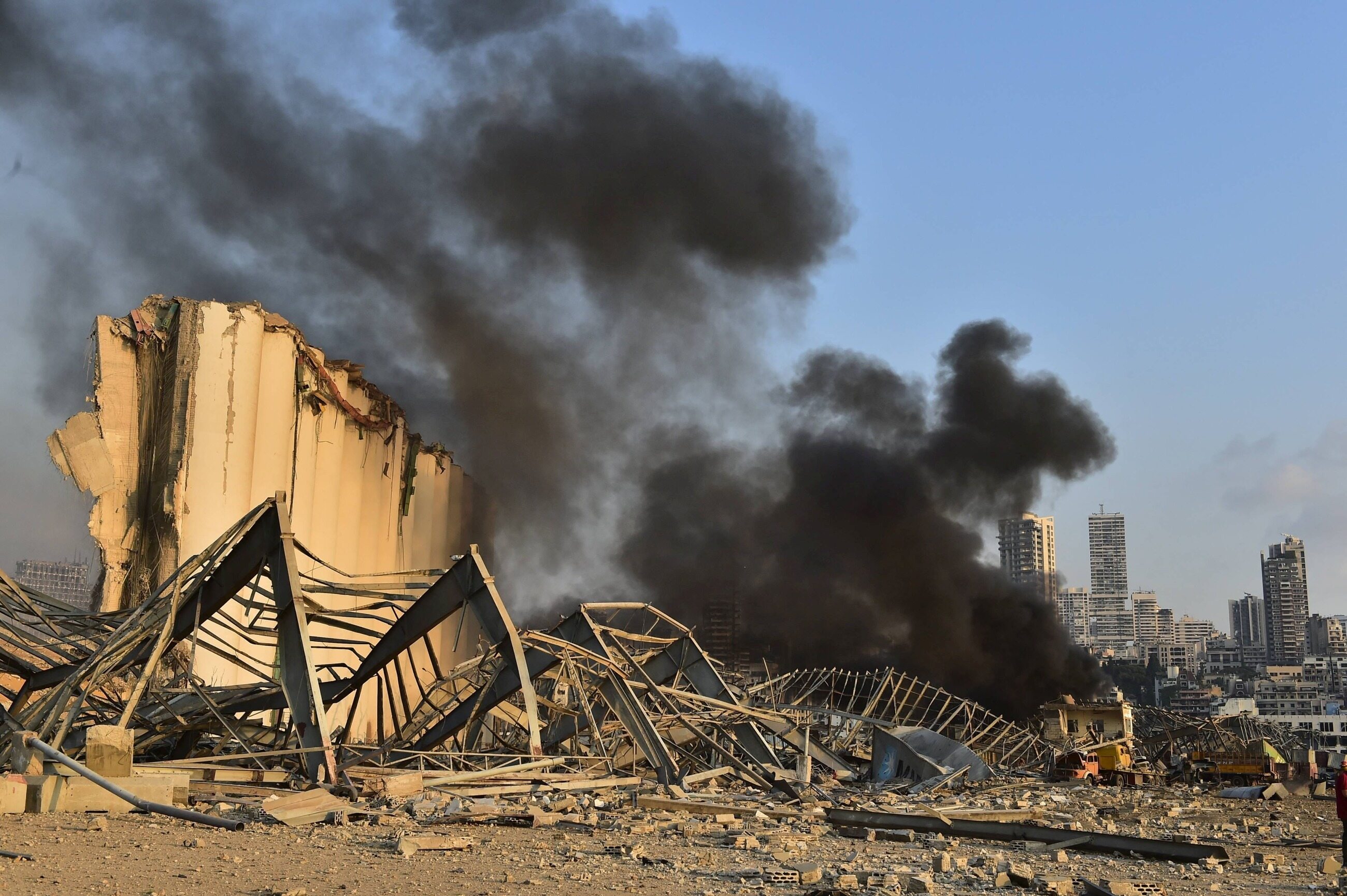

Beirut harbor after explosion in Hezbollah's warehouse.

Thursday, 5 March 2026

We are Sunni Jewish state :)

 Many years ago, before the current war, before October 7, before the upheavals in my life, and even before Covid (do you remember those beautiful times?), I attended a very interesting meeting with an Israeli journalist, reporter, and commentator, organized as part of the Jewish Culture Festival in Krakow.

The meeting concerned, among other things, the geopolitical situation, Israeli politics, and its possible consequences. The host of the meeting spoke, among other things, about the differences in attitudes toward military service in the West Bank among fresh olim (immigrants to Israel) from different countries. Depending on the thought patterns and experiences acquired before immigration, the same duties, orders, and situations provoked extremely different reflections and reactions.

One of the questions that came from the audience was whether, in the long run, Israel is capable of reconciling its deeply humanistic approach to all minorities, its commitment to individual rights, openness, and the enormous, enormous energy of life with the necessity of ensuring the population's security, suppressing terrorism, and counteracting it. And how military service under these conditions affects the attitudes and behaviors of the very young soldiers who are still mostly so (olim are somewhat of an exception here).

The speaker reflected on this difficult question and admitted that the matter is difficult, raises concerns, and is fervently discussed in certain circles. Indeed, for a state built on leftist ideals, still optimistically looking at relations with its neighbors, these issues were difficult to balance. Nevertheless, as he concluded in a lighter tone, there is hope, because 'recently we discovered that we are a Jewish Sunni state in the Middle East.'

That was 8 years ago. The world has changed incredibly (and not for the better, in my humble opinion). Nevertheless, looking today at the tragic war with Iran I think about these words.

Iran has tried not only to destroy Israel since the beginning of the Ayatollahs' republic (I once wrote about the excellent relations between the two countries before the revolution). Israel was Iran's main target, but closely behind it was the desire for hegemony in the Middle East. Iran is a huge, populous, and ambitious country (sometimes in a criminal or tragic way, yet ambitious) and the Ayatollahs definitely wanted to be the main force in the region. Nevertheless, all the differences with most Arab countries played against them. Religious divisions (Shiite Iran versus Sunni majority of the Gulf states), linguistic (Persian versus Arabic), ethnic (Persians versus Arabs), and the not necessarily welcome political ambitions of Iran were a great obstacle. In the Ayatollahs' plan, a common enemy (Israel) and a shared grievance (emphasized grievance of the Palestinians) were supposed to unite. Undoubtedly, during the period of the revolution's victory in Iran, this worked, at least roughly speaking. Nevertheless, the revolution in Iran was preserved like an old photograph, and while Khomeini was a revolutionary, Khamenei was in many ways was the custodian of the revolution.

Khomeini and Arafat had a lot in common (support from the KGB and Moscow, political role in a bipolar world, partially similar goals). Khamenei had much less in common with various leaders, both of states and terrorist groups, in the Middle East.

Israeli diplomacy has for years tried to get closer to its Arab neighbors. Not without success. With the end of Nasser's era and the dominance of pan-Arabism, the chances increased. Peace with Egypt in the 1970s and with Jordan in the 1990s greatly improved the situation. In 2023, the signing of the Abraham Accords with Saudi Arabia was close.

This was perceived as a great threat by Iran – its militias did everything they could to torpedo such a move, as well as by Hamas. Iran, after creating and arming Hezbollah, vassalizing Lebanon, largely colonizing Iraq, and winning a proxy war with Saudi Arabia in Yemen, could not afford normalization of relations between Saudi Arabia and Israel. It could not, and neither could Hamas, hence the attack on October 7 (in the following week, the Abraham Accords were supposed to be finalized).

Surely both Hamas and Iran thought that 2023 would be a blow to Israel that would bring them closer to 'pushing the Jews into the sea.' The blow was cruel. The largest, bloodiest massacre of Jews since the Holocaust, the world's lack of compassion, accusations of genocide even before the war in Gaza began. The first major clash with Iran in 2025. It seemed that hopes for an alliance had at least greatly faded.

Today, when Iran is sending missiles not only at civilian targets in Israel (including apparently Jerusalem, so important to Muslims), but also at the United Arab Emirates, Oman, Qatar, Kuwait, Saudi Arabia, Cyprus, it may turn out that Iran's desire to destroy Israel was the best catalyst for Israel's understanding with its neighbors.

A Jewish Sunni state?

Monday, 2 March 2026

Why nothing was done before? WHY? (part 2)

 The war is ongoing. Terrible, because every war, even a necessary one, is terrible. Is this a necessary war? And did it really start yesterday? Could it have been prevented? Could the world, which today began a traditional session of condemnation, have done something and did it want to do something?


In my opinion, the answer to these questions is: it could, but it definitely did not want to. Where do such (my) conclusions come from?

Here is a continuation of the analysis that began yesterday in the heat of the moment.

Chapter III What was the attitude of the Iranian regime towards Israel since 1980 (from the beginning).
Since the 1979 Islamic Revolution, Iran's Islamic regime has openly made the elimination of the State of Israel a top priority and has made it a central element of its ideology. The U.S. appeared in this ideology as the "Great Satan" and Israel as the "Little Satan."
September 9, 2015 Khamenei declared that Israel would be eliminated within 25 years. In June 2017, in Palestine Square in Tehran, the ayatollahs set a clock to count down the maximum of 25 (then less) years until the annihilation of Israel.
In 2018, Revolutionary Guard commander Gen. Hossein Salami said that "there is no other way but to throw [the Israelis] into the sea," and in 2020, the same general urged the Israelis to "take a good look at the Mediterranean, which will be their final dwelling." In his speech, he added that "our Hezbollah is enough to destroy this political, cancerous tumor [Israel]." thus admitting (as if anyone had any doubts) that Hezbollah is an Iranian creation and that its mission is to destroy Israel.
In 2019, Majlis member Mohammad Baqer Ebadi advised Israeli Prime Minister Benjamin Netanyahu to "start learning to swim in the Mediterranean." He added that Israel's doomsday was approaching and that Israelis would trample each other while trying to escape.
Mahmoud Ahmadinejad, while still president of Iran, became famous for statements (some delivered at the UN) such as: "A world without the United States and Israel is desirable and achievable," "We don't have homosexuals in Iran like you do in America," and "Iran can recruit hundreds of suicide bombers a day. Suicide is an invincible weapon. Suicide bombers in this country have shown us the way and illuminate our future." Finally, "the use of nuclear weapons is Iran's right." For years, the Iranian authorities have not only called for the destruction of Israel, but also established, financed, and armed terrorist organizations directed against Israel.
Iran has called for the destruction of Israel, threatened to destroy Israel, built infrastructure to destroy Israel, praised terrorists, and praised the October 7 attack, yet none of this has been taken seriously in the West.

Chapter IV: The Ayatollahs and the Iranians
How did the regime treat Iranians? Those who didn't support it, as well as all women, Baha'is, homosexuals, and independent thinkers, were treated cruelly. Women were veiled, married off (on Khomeini's orders) before they started menstruating, raped after arrest, and subjected to the political police. Homosexuals were publicly hanged from cranes. Efforts were made to exterminate the Baha'is.

Summary Iranians protested repeatedly, and Western intellectuals expressed concern and outrage. However, when Israel turned against the regime or its offshoots, it was accused of aggression. One may disagree with the Israeli government (every government, including the current and most controversial one, the regime in Tehran treated everyone equally). However, turning a blind eye to threats, calls, and preparations for annihilation is siding with the perpetrator. And that is not Israel. Israel has never been bothered by Iran's existence, and until 1980, it had friendly relations with it. Just as Ukraine was not bothered by Russia's existence. However, ignoring, or—worse—tacitly sanctioning, Iran's threats and efforts to carry them out is a different matter. One Shoah survivor once said: "When someone tells you they want to kill you, believe them." Israel believed them. After October 7th and Iran's praise of them, it could not have done otherwise. And let me remind you who the Redzikowo base was against, who sells shaheed to Russia, who expresses hope for the fall of the West and takes steps to bring about such a turn of events? And going further, I'll recall the West's irritation with Poland's refusal to cede the corridor to Hitler, and the ceding of Czechoslovakia to him as a guarantee of "peace for our generation," and Chamberlain's betrayal of German officers who were preparing for a coup and Hitler's ouster in 1938. Peace seems blissful and priceless as long as others pay for its maintenance, as long as others are the appetizer (never the whole meal) of criminal dictatorships.
Could today's war have been prevented? Yes, years ago, by reacting (correctly) to the ayatollahs' threats, by deploying peacekeeping forces in Lebanon as required instead of sending them there on vacation, by reacting to the anti-Semitism that has been consuming the Western left for years, by calling the ayatollahs' regime's crimes against Iranians by their proper names, by showing a modicum of shame when they listed beautiful values ​​one by one, just enough for some action to follow, by naming the criminals after October 7th. But they didn't. Trump and Netanyahu are certainly not motivated by a desire to establish the rule of law in Iran and provide relief to the Iranian people. Both are concerned with their own interests, and Netanyahu also cares about the survival of his country (which is his role). I fully understand that one might dislike many things, but the time to prevent such an escalation has long passed. It was not used. There was time to point the finger of blame (and it wasn't used). War is terrible, and politicians, well, behave like average politicians. Only this situation didn't arise yesterday. It had been brewing for 45 years, and the Western left's beauties did everything they could to avoid seeing it.